
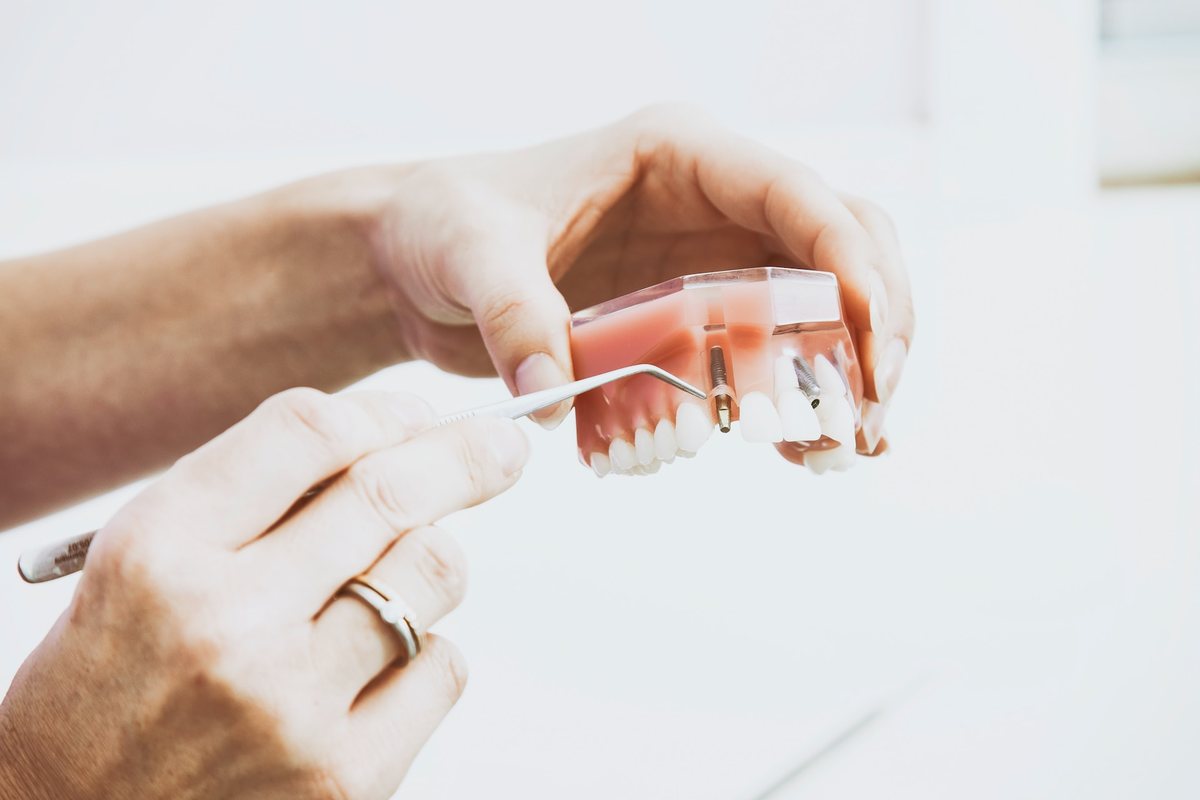
An implant is a titanium post placed into the jawbone, acting as an artificial tooth root. Once the bone has grown around it, a crown goes on top and you have a tooth that is fixed, functional and looks like the rest.
Implants are the closest dentistry gets to replacing a tooth outright. Unlike a bridge, they do not require cutting down the healthy teeth on either side, and unlike a denture they do not move.
The trade-off is time. Bone needs months to fuse to the post, so the whole process runs over several appointments — worth knowing at the outset so the timeline doesn't come as a surprise.
What it costs
$3,000–$6,000 for a single tooth, start to finish
| Implant post — the titanium root that goes into the jaw | $1,000–$3,000 |
|---|---|
| Abutment — the connector between post and tooth | $400–$1,000 |
| Crown — the part you see and chew with | $800–$3,000 |
| All three together, one tooth | $3,000–$6,000 |
| Bone graft, if the site needs one first | $400–$1,500 |
These are typical United States ranges for 2026, gathered from published fee surveys — they are not a quote from this practice. What you actually pay depends on your own mouth and your own plan. You get that figure in writing after an exam, before anything is scheduled.
What moves the number:
- Whether there is enough bone in the socket, or whether it needs grafting first. Bone recedes once a tooth is gone, so the longer the gap has been there, the likelier a graft becomes.
- The crown material. Zirconia costs more than porcelain-fused-to-metal and holds up better on back teeth that do the heavy chewing.
- Whether the failing tooth still has to come out — that extraction is a separate fee, though it is often done the same day as the implant.
- Your annual maximum. Most dental plans cap out around $1,500–$2,000 a year, which rarely covers a whole implant inside one calendar year. There is a way around that, below.
How many visits, and how long the whole thing takes
An implant is not slow because it is difficult. It is slow because bone grows at the speed bone grows at, and nothing hurries it.
Placing the post is a single appointment, usually about an hour, under local anaesthetic. Then the jaw is left alone for roughly three to six months while the bone fuses to the titanium — the process is called osseointegration, and it is what makes an implant behave like a real root rather than a peg stuck in a hole. When it has taken, we fit the abutment and the crown over one or two short visits.
So: two or three appointments, spread across four to eight months, with a long quiet stretch in the middle where you are simply getting on with your life. If the gap is somewhere visible, you will not be walking around with a hole in your smile while you wait — we sort out a temporary.
What the recovery is actually like
Most people are surprised by how mild it is. Implant surgery is a precise procedure through a small opening, and it tends to be gentler than the extraction that preceded it.
Expect soreness and some swelling for two or three days, manageable with ibuprofen. Soft food for about a week. The majority of patients go back to work the next day. You will be told what to watch for and given a number to ring if anything feels wrong — you will not be sent home to guess.
Spreading the cost across two plan years
This is the single most useful thing on this page and almost nobody knows it. Dental benefits reset every 1 January and unused annual maximum does not roll over — it evaporates.
An implant is naturally a two-stage treatment with months in between, which means the stages can straddle a year end. Extraction and graft in the autumn against this year's maximum, crown in the new year against next year's. Two annual maximums applied to one tooth. It takes a little planning at the front desk and it can be worth well over a thousand dollars.
Common questions
How long do implants last?
Decades, and often for life, with normal brushing and regular checkups.
Am I a candidate?
Most people are. It depends chiefly on how much bone is there, which an X-ray settles quickly.
Questions about dental implants?
Call the office and ask. We'd rather talk it through than have you guess from a website.